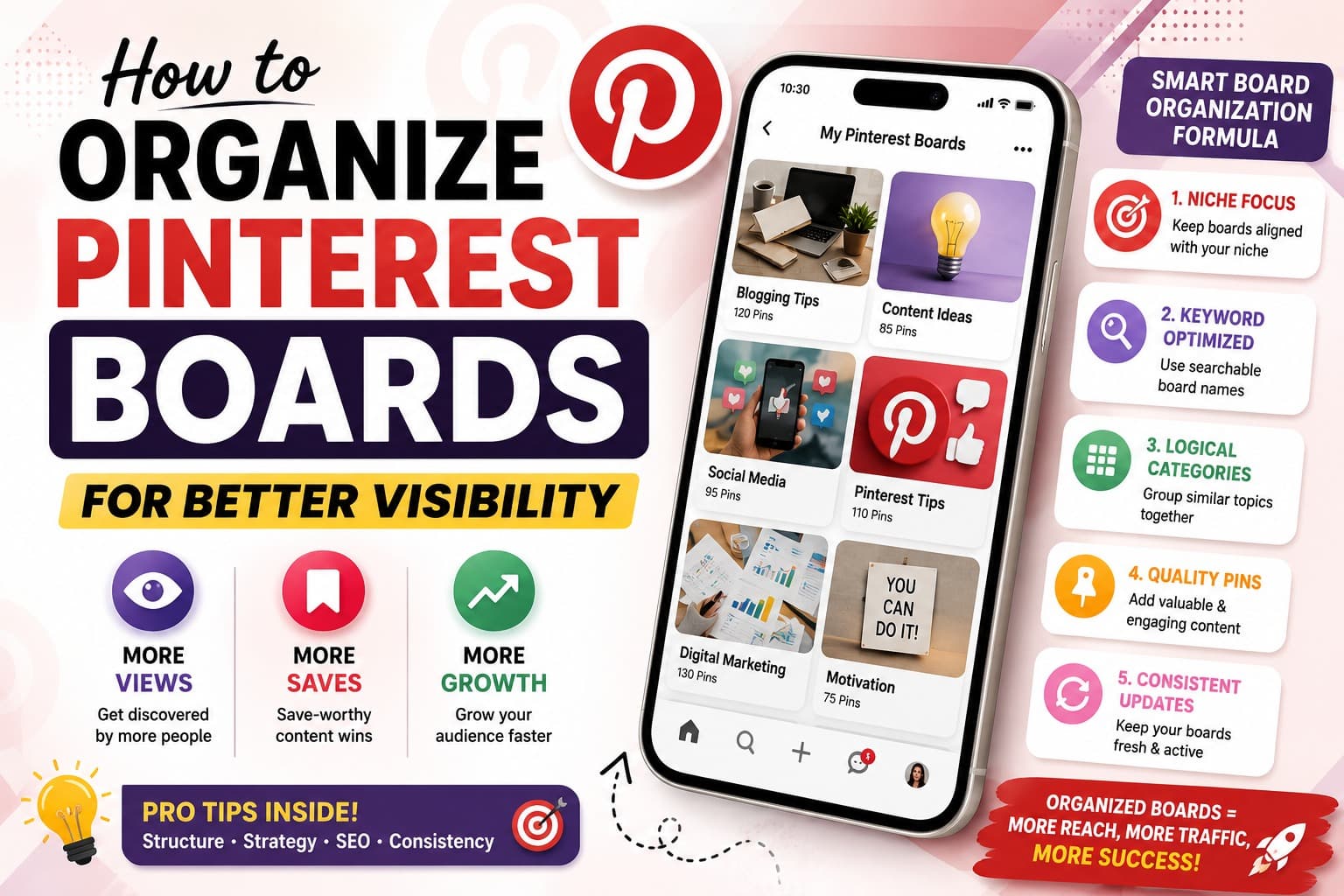
Most people treat Pinterest boards like simple folders—just a place to dump pins and move on. That's where growth quietly starts to slow down without them even realizing it.
On the surface, boards look like an internal organizing system. But in reality, Pinterest doesn't see them as storage at all. It reads them as meaning signals. Every board tells Pinterest what your account is about, who should see your content, and how confidently it can classify your niche.
When boards are messy, overly broad, or randomly created, Pinterest doesn't get a clear identity signal from your account. And when the platform is unsure, your reach becomes unstable—sometimes good, sometimes dead, and rarely consistent.
So board organization isn't a visual or cosmetic task. It is part of your Pinterest SEO foundation.
Why Pinterest Boards Matter More Than Most Creators Realize
Most beginners obsess over pin design, templates, and keywords inside descriptions. Those are important, but they only represent one layer of the system.
Boards act like the structural context behind every pin you publish.
- Which board you saved it to
- What type of content already exists in that board
- How consistent that board's theme is
- Whether your boards collectively define a clear niche
When you upload a pin, Pinterest doesn't evaluate it in isolation. It also analyzes:
This means your boards silently influence ranking, even before a pin gets engagement.
If your boards are inconsistent, Pinterest struggles to categorize your entire account. And when categorization is unclear, distribution becomes cautious.
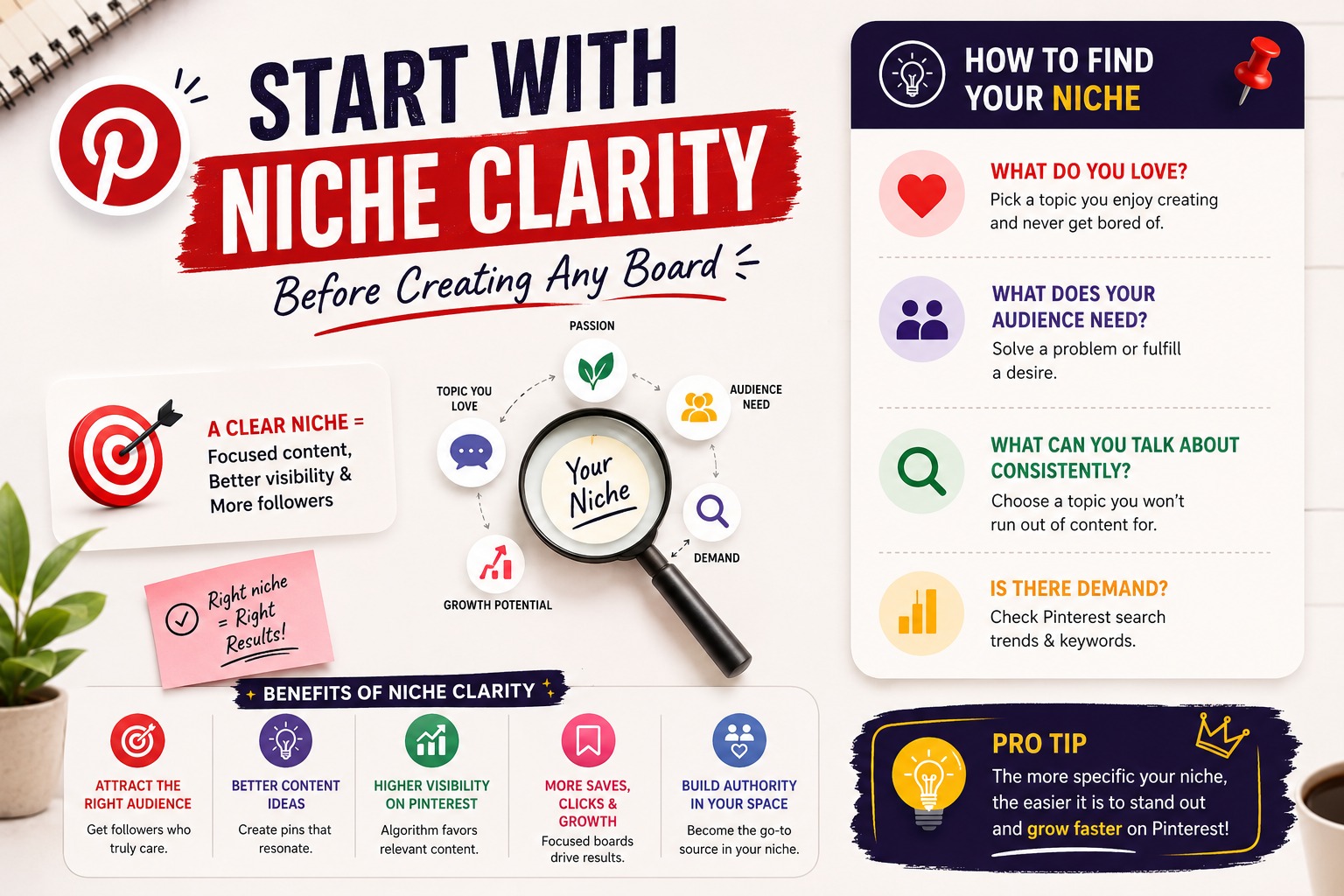
Start With Niche Clarity Before Creating Any Board
The biggest mistake beginners make is rushing into board creation without defining a content identity.
Pinterest doesn't reward scattered interests, especially in the early stage of an account. It prefers clarity over variety.
Before creating boards, ask a more important question:
What is the core theme of my account?
Not "what boards should I make," but "what should my account represent?"
- If your focus is Pinterest growth, your ecosystem should revolve around SEO, traffic strategies, content creation, and keyword research.
- If your focus is blogging, your boards should support writing, monetization, SEO structure, and niche building.
- If your focus is lifestyle content, your structure still needs organization—fitness, routines, productivity, personal growth, etc.
For example:
The key principle is simple: Pinterest needs to see one connected topic universe, not unrelated fragments.
The Ideal Pinterest Board Structure for Better Growth
A well-structured Pinterest account is not about having more boards—it's about having the right layers.
A balanced structure usually looks like this:
Core Topic Boards (Foundation Layer)
These are your primary identity boards. They define your niche.
- Pinterest Growth Strategy
- Blogging & SEO Traffic
- Content Marketing Strategies
For example:
These boards should receive most of your pins because they directly reinforce your authority.
Supporting Topic Boards (Expansion Layer)
These are secondary but still tightly connected to your niche.
- Keyword Research Techniques
- Social Media Growth Tips
- Content Planning & Ideas
For example:
These boards help Pinterest understand depth in your topic. They show that your knowledge is not surface-level.
Long-Term Evergreen Boards (Optional Layer)
These boards expand reach into adjacent but still relevant topics.
- Productivity for Creators
- Online Business Growth
- Digital Skills Development
For example:
But here's the important part—these should never drift too far from your main niche. Random inspiration boards weaken your clarity.
Board Naming Strategy That Actually Improves Reach
Board names are not creative expressions. They are search signals.
Pinterest behaves more like a search engine than a social platform. That means clarity always beats creativity.
- Matches real search intent
- Includes natural keywords
- Clearly defines the topic in one glance
A strong board name:
- My Ideas
- Growth Stuff
- Random Tips
**Weak examples:**
- Pinterest SEO Tips for Beginners
- Blogging Traffic Growth Strategies
- Social Media Marketing Ideas
**Strong examples:**
The difference is simple: one is vague, the other is searchable.
Pinterest uses board titles to understand topical relevance, especially for newer accounts where authority signals are still forming.
Why Board Descriptions Actually Matter for SEO
Most creators completely ignore board descriptions, which is a missed opportunity.
- What content belongs inside the board
- Which keywords define that topic cluster
- How the board connects to user search behavior
A board description helps Pinterest understand:
But this is where many people go wrong—they start stuffing keywords unnaturally.
A good description doesn't feel like SEO writing. It feels like a simple explanation of purpose.
For example:
"This board focuses on practical Pinterest SEO strategies, keyword research techniques, and content growth methods for creators who want to build consistent traffic and visibility on Pinterest."
It's not complicated, but it gives Pinterest a clear semantic direction.
The Hidden Problem: Mixing Unrelated Content
One of the biggest reasons accounts struggle to grow is internal confusion caused by mixed topics.
At first, it seems harmless—saving different types of content in the same board. But Pinterest doesn't interpret it casually.
It tries to identify patterns.
- What audience it belongs to
- What search queries it should appear in
- What topic authority it represents
When a board contains unrelated topics, Pinterest cannot clearly define:
This leads to inconsistent impressions and unstable reach.
Focused boards, on the other hand, create strong topical clarity, which improves distribution confidence.
How to Distribute Pins Across Boards Properly
Board structure alone is not enough. Distribution also matters.
- Core boards receive most of your pins
- Supporting boards receive related but secondary content
- Avoid spreading one pin across too many unrelated boards
A healthy distribution strategy looks like this:
Pinterest prefers depth over duplication.
It's better to have fewer active, well-defined boards than a large number of inactive or loosely maintained ones.
Board Order Matters More Than You Think
Your Pinterest profile is not neutral—it has hierarchy.
The boards placed at the top of your profile receive more visibility and are often the first signal Pinterest and users see.
That means your strongest, most niche-defining boards should always be positioned first.
Think of your profile like a landing page. The first section defines perception.
If your strongest boards are buried, you lose early clarity signals.
Boards Should Evolve, Not Stay Static
Pinterest is not a one-time setup platform. It's dynamic.
As your account grows, your content direction becomes clearer. Some boards will perform better than others. Some will become irrelevant.
Instead of constantly creating new boards, refine existing ones.
- Merge overlapping boards
- Improve naming for clarity
- Update descriptions for better SEO alignment
- Remove off-topic pins
You can:
This keeps your account structured and strengthens topical authority over time.
Final Thoughts
Pinterest boards are not passive folders—they are active classification signals that shape your entire visibility system.
When your boards are structured properly, Pinterest doesn't have to guess what your account is about. It already knows.
And once that clarity is established, your reach becomes more stable, predictable, and scalable.
The goal is not to create more boards. The goal is to create the right structure that builds trust with Pinterest's algorithm over time.
Because in the end, strong Pinterest growth doesn't come from more content alone—it comes from organized meaning behind that content.