Most people treat Pinterest and Instagram like they work the same way.
Both are visual platforms. Both rely heavily on images. Both involve content creation, audience attention, and engagement.
So naturally, many beginners assume traffic growth should behave similarly on both platforms.
But once you actually start using them seriously, the difference becomes obvious very quickly.
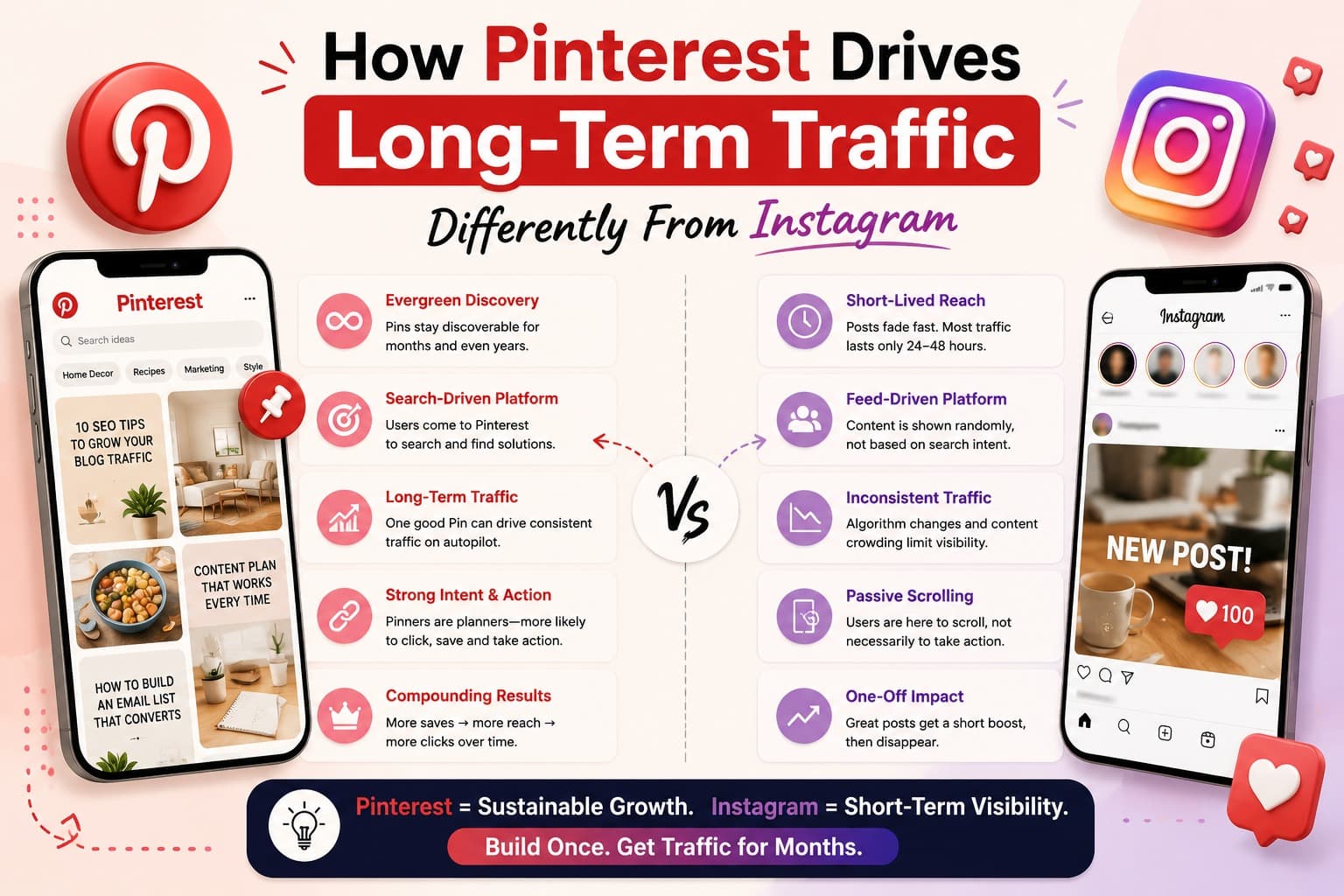
Instagram is built around attention.
Pinterest is built around discovery.
And that single difference changes almost everything about how traffic behaves over time.
A lot of creators spend months trying to force Instagram-style growth strategies onto Pinterest without realizing the platforms reward completely different user behavior.
That’s why many people feel confused when Instagram content gets engagement but disappears within days, while a single Pinterest pin quietly continues driving traffic for months — sometimes even years.
The platforms operate on fundamentally different systems.
And understanding that difference is extremely important if your goal is long-term website traffic instead of short-term visibility.
Instagram Prioritizes Immediate Attention
Instagram moves incredibly fast.
Content appears, gains engagement quickly, and then slowly disappears from visibility as newer content replaces it.
That’s not necessarily a flaw.
It’s simply how the platform is designed.
Instagram heavily rewards recency, engagement velocity, and active audience interaction.
A reel performs well for a few days.
A carousel gets engagement for a short period.
Stories disappear almost immediately.
Even strong content often has a relatively short visibility cycle unless the algorithm continuously pushes it forward.
This creates a very different kind of creator behavior.
People constantly feel pressure to keep posting.
Because the moment content stops, visibility usually drops quickly too.
The platform depends heavily on maintaining continuous attention.
And honestly, this can become exhausting over time — especially for creators trying to drive stable website traffic instead of only social engagement.
Pinterest Behaves More Like a Search Engine Than a Social Platform
This is the part many people misunderstand.
Pinterest may look like a social platform on the surface, but underneath, it behaves much closer to a visual discovery engine.
People don’t usually open Pinterest looking for entertainment in the same way they open Instagram.
They search with intent.
Recipes.
Home ideas.
SEO tips.
Business strategies.
Travel inspiration.
Fashion references.
Website design ideas.
Solutions.
That changes how traffic works completely.
Because when users search intentionally, content becomes discoverable long after it was originally published.
A Pinterest pin is not competing only in the moment it gets posted.
It can continue appearing in search results, recommendations, and related feeds for months if the topic remains useful.
That creates a compounding effect Instagram rarely provides organically.
Pinterest Content Has a Much Longer Lifespan
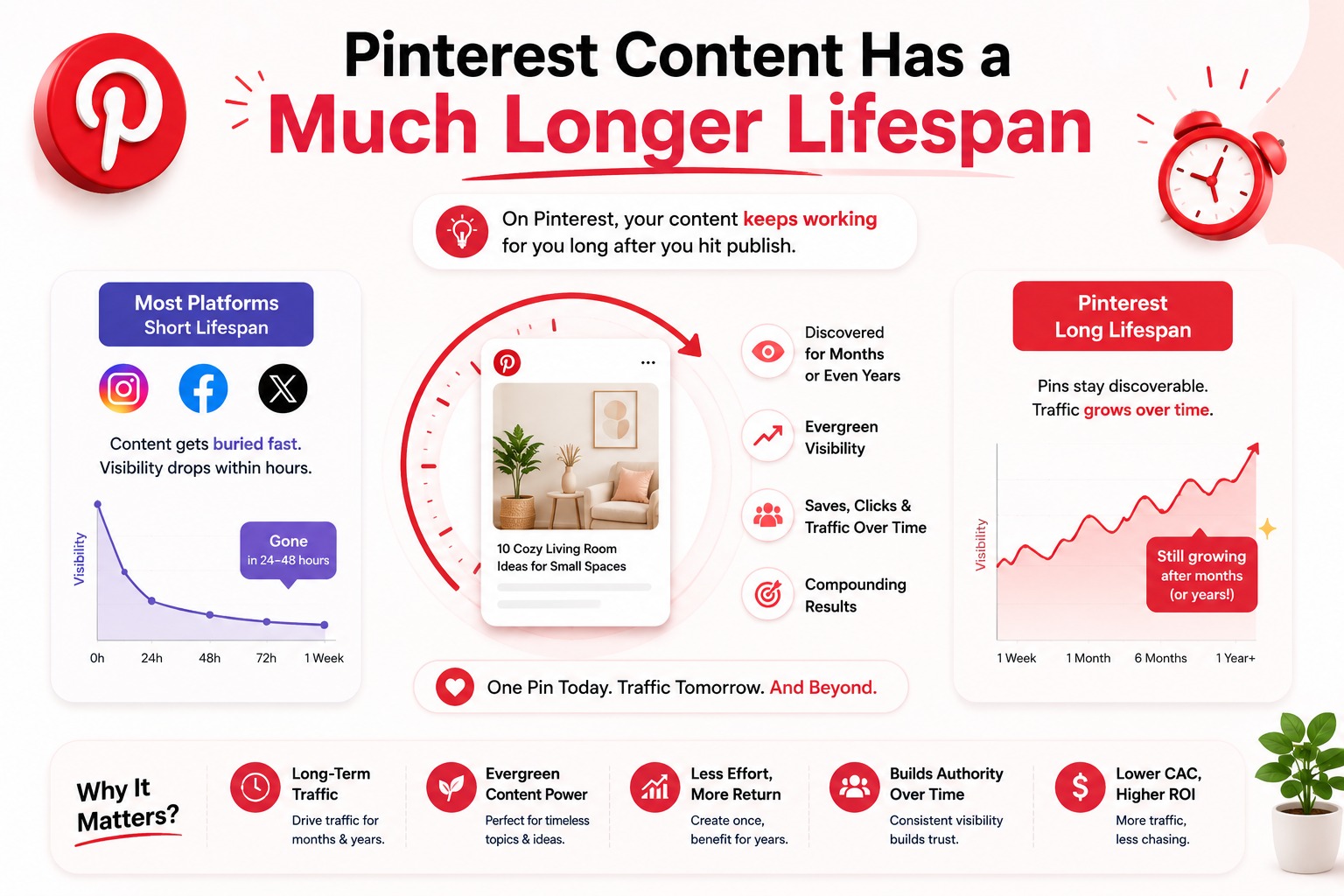
One of the biggest differences between Pinterest and Instagram is content longevity.
On Instagram, most posts experience a sharp visibility spike followed by rapid decline.
Even excellent content often loses momentum within days.
Pinterest behaves differently.
A pin may start slowly.
Sometimes very slowly.
For weeks, traffic may barely move.
Then gradually, impressions increase.
Search visibility improves.
Saves increase.
Clicks begin compounding.
And suddenly, a pin created months ago starts becoming a consistent traffic source.
This is why Pinterest rewards patience much more than Instagram does.
Growth feels slower initially, but the lifespan of content becomes significantly longer.
A well-optimized Pinterest pin can continue driving website traffic long after the creator forgets about publishing it.
That’s extremely powerful for blogs, niche websites, affiliate content, and evergreen resources.
Because instead of constantly replacing old visibility with new content, Pinterest allows older content to continue working in the background.
Pinterest Traffic Usually Comes With Stronger Intent
Another major difference is user mindset.
Instagram users are often browsing passively.
They consume content quickly while scrolling.
Attention spans are shorter.
The goal is usually entertainment, inspiration, or social interaction.
Pinterest users behave differently.
They actively search for ideas, solutions, tutorials, and future plans.
Someone searching on Pinterest for:
“small bedroom design ideas”
or
“SEO blog structure”
already has intent behind the search.
That matters because intent usually creates better traffic quality.
Pinterest users are often more willing to: read articles, save resources, explore websites, revisit content later, or take action after clicking.
This is one reason Pinterest traffic often performs surprisingly well for bloggers compared to some other social platforms.
The traffic is not purely reactive.
It’s problem-solving traffic.
And problem-solving traffic tends to stay valuable longer.
Instagram Growth Depends More on Audience Retention
Instagram growth is heavily connected to maintaining audience attention consistently.
Creators often need: frequent posting, high engagement, strong hooks, short-form optimization, trend adaptation, and constant content momentum.
That system favors creators who can continuously produce attention-grabbing content.
Pinterest works differently because discoverability matters more than constant audience retention.
A smaller account can still generate strong traffic if the content aligns well with search demand and user intent.
That makes Pinterest feel less dependent on personal branding compared to Instagram.
The content itself often matters more than the creator identity.
And honestly, that’s one reason many bloggers quietly prefer Pinterest for long-term traffic generation.
The platform gives evergreen content more room to survive.
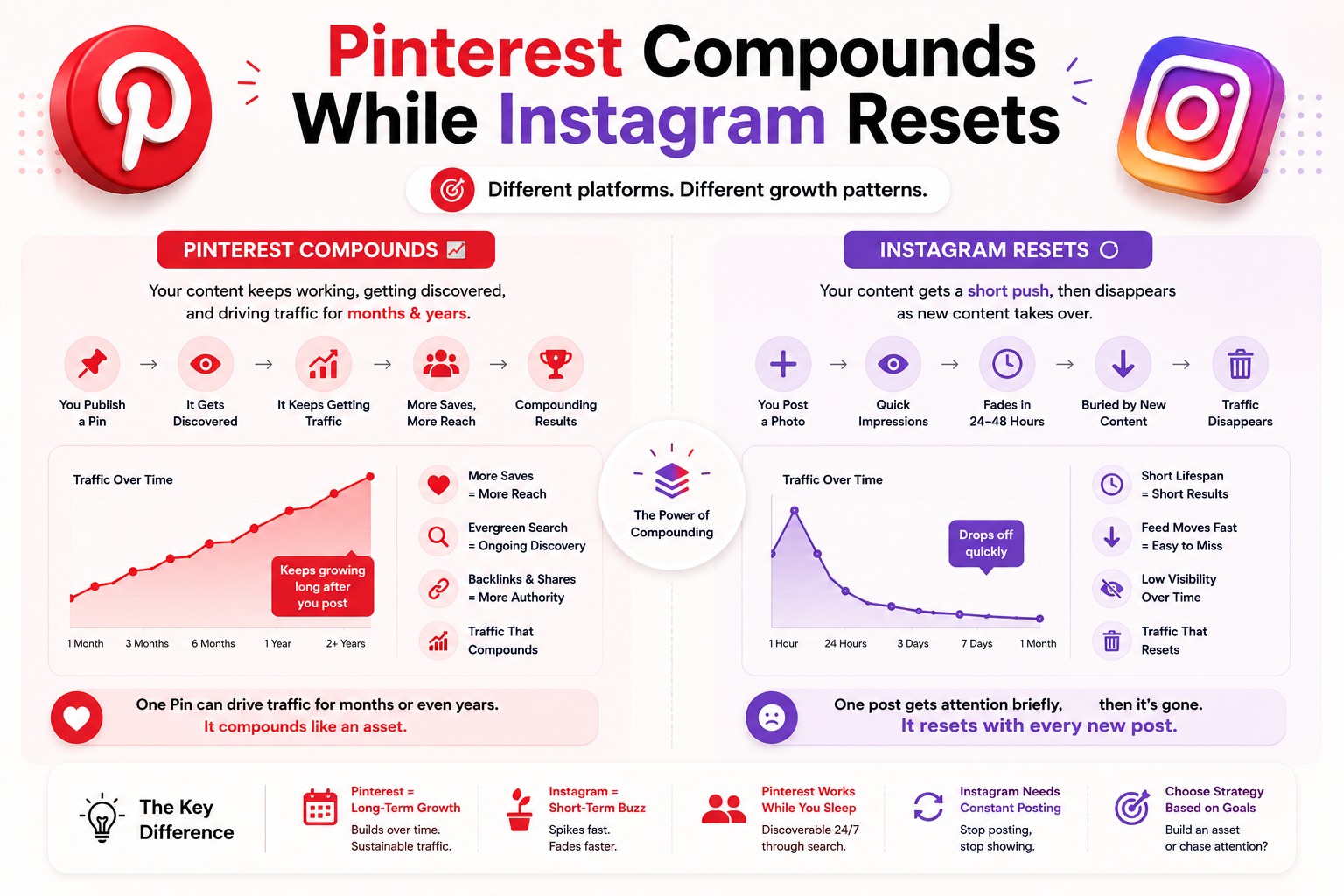
Pinterest Compounds While Instagram Resets
This is probably the simplest way to explain the difference.
Instagram traffic often resets.
Pinterest traffic often compounds.
On Instagram, visibility usually depends on maintaining current momentum.
On Pinterest, visibility can continue growing gradually from older content assets already published.
That changes how creators approach strategy.
Pinterest rewards building libraries of discoverable content.
Instagram rewards maintaining active attention cycles.
Neither system is necessarily better universally.
They simply serve different goals.
If the goal is brand visibility, community engagement, or rapid audience interaction, Instagram can be incredibly powerful.
But if the goal is long-term website traffic, evergreen discoverability, and compounding content reach, Pinterest often behaves much more sustainably.
Most People Expect Pinterest to Work Too Fast
One reason many beginners quit Pinterest early is because they expect Instagram-style feedback loops.
They publish pins and expect immediate clicks.
When that doesn’t happen, they assume Pinterest “doesn’t work.”
But Pinterest rarely rewards impatience.
The platform often needs time to understand: content relevance, user interaction patterns, topic associations, and search behavior.
This means Pinterest growth can feel slower initially.
But once the system starts understanding your content ecosystem, traffic can become remarkably stable compared to short-term social spikes.
That’s why consistency matters so much on Pinterest.
Not viral bursts.
Steady publishing.
Clear topical direction.
Strong visuals.
Useful content.
Over time, those signals compound together.
Final Thoughts
Pinterest and Instagram may both look visual on the surface, but they drive traffic in completely different ways.
Instagram is built around fast-moving attention cycles.
Pinterest is built around long-term discovery.
One prioritizes engagement momentum.
The other prioritizes searchable relevance.
That difference changes how content survives, how users behave, and how traffic compounds over time.
And honestly, many creators underestimate how valuable long-term discoverability becomes until they experience it firsthand.
Because temporary attention feels exciting.
But sustainable traffic creates stability.
And Pinterest is one of the few platforms where older content can continue generating meaningful traffic long after it was originally published.